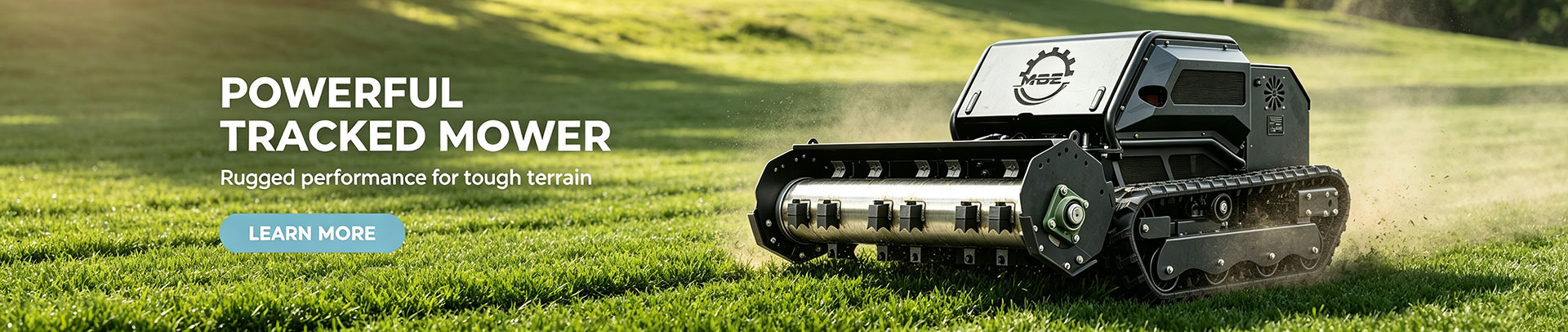

The "pain" in lawn mowing is rarely about cutting grass itself. It is about who does the work, how dangerous the ground is, how hard it is to reach, and how much it costs. Across orchards, slopes, riverbanks and photovoltaic stations, vegetation management faces a familiar set of problems — and these are exactly the problems remote-controlled crawler mowers were designed for. The honest question is not whether Maideen can solve every one of them, but which ones it genuinely solves. Here is that answer.
1. Labor shortage and rising labor costs. Finding workers who are willing to do heavy, repetitive mowing is harder every year, and wages keep climbing. Manual weeding on flat ground alone can cost far more per acre than mechanical mowing, and the cost doubles on slopes and overgrown ground. Maideen answers this with a machine that does the work of several people under the control of a single operator, covering a much larger daily area. The point is not that the machine removes the operator entirely — it still needs one person — but that it removes the dependence on finding many people, and it replaces a high wage bill with a machine that works the whole day on fuel and minimal maintenance.
2. Safety on steep slopes and dangerous ground. Slips, falls and rollovers on steep embankments, riverbanks and terraced hillsides are a real and recurring danger. Maideen's remote control — up to roughly 500 meters depending on the model — lets the operator stand on safe, flat ground while the machine does the cutting. Emergency braking and collision sensors add basic protection, and the low, tracked chassis grips well enough to handle slopes of up to 60 degrees without slipping. People no longer have to set foot on the most hazardous ground. The honest boundary: truly extreme slopes, cliff-like terrain, and dense vegetation with no access channel remain beyond any machine's reach.
3. Access to difficult terrain. Wheeled and hand-pushed mowers slip on mud, stall on gravel and roll over on slopes; orchards are often planted on hilly ground with narrow, uneven rows. Maideen's crawler chassis — durable rubber tracks reinforced with internal steel wire — spreads the machine's weight, reduces soil compaction, protects tree roots and keeps traction on muddy and rocky ground. The line offers different sizes, so row spacing and terrain can be matched with a suitable model. The boundary: extremely narrow, densely planted rows and very low-hanging branches can still limit access.
4. Low efficiency and uneven results. A worker on foot simply cannot cover large areas quickly, and hand-cutting leaves uneven stubble and missed patches, letting weeds compete with crops for nutrients and water. Across the Maideen line, cutting width, adjustable cutting height and working speed are matched to each model's intended terrain. The rotary cutting system mulches clippings evenly and handles small bushes, so a large area can be cleared in a fraction of the manual time with a far more uniform result. This is where the improvement is easiest to measure.
5. Power supply in remote, off-grid sites. Many slopes, riverbanks and station grounds have no reliable external power. Maideen's fuel and hybrid models with built-in generating systems keep working for long stretches without charging stops, which matters for large, remote jobs.
6. Adapting to different farming practices. No two operations are identical. Maideen supports accessories such as side-cutting and spraying, plus customization including voltage, color and branding options, and OEM/ODM services for partners — so the machine can be shaped to the actual work rather than the other way around.
So has Maideen solved the industry's pain points? The fair answer is: it has systematically addressed the core ones — finding labor, climbing slopes safely, getting into difficult terrain, and doing the job faster and more evenly. It has not claimed to be a universal solution, and no machine is. What matters is that the problems customers complain about most are the problems the Maideen range was built to answer — and it keeps improving those answers season after season.
WhatsApp:+852 5462 5594
Mobile: +852 5462 5594
Email: [email protected]
Address: No. 26 Jiacheng Road, Economic and Technological Development Zone, Jining City, Shandong Province
We chat